What is UKBOTA
ℹ️ UKBOTA is affiliated with the Radio Society of Great Britain (RSGB), as well as being an official affiliated club (AFS) we are also formally recognised as an RSGB Special Interest Group (SIG). You can frequently read about UKBOTA activities in the RSGB’s magazine Radcom and on GB2RS news. UKBOTA is also a club member of the Royal Air Force Amateur Radio Society (RAFARS).
🏆 Free awards for activating and hunting bunkers are available but it’s also okay if you’re not interested in awards and just want to get involved by having a QSO or shortwave listening. Whatever your approach – have fun!
HISTORY
ℹ️ Bunkers on the Air (BOTA) began in 2003 as a unique and innovative way to merge the fascinating world of amateur radio with the rich history of military and civil defence bunkers. It offered radio enthusiasts a chance to not only enjoy their hobby in a new and adventurous way but also to explore and bring attention to often-forgotten historical sites. In the UK, this initiative took on a particular focus on the activation of Royal Observer Corps (ROC) posts—small, often hidden structures that once formed a vital part of Britain’s Cold War defence system. These sites, scattered across the country, have become symbolic of a time when vigilance and communication were at the heart of national security. The original concept of activating bunkers came from Brian G8GMU and his grandson Joshua M3HBM, who, alongside members of the Coventry Amateur Radio Society, began visiting and activating ROC posts in their local area nearly two decades ago. What started as a personal and club-level initiative soon captured the imagination of others in the amateur radio world. By 2010, this grassroots idea had grown in scope and momentum. It was formally brought under the umbrella of the Castles and Stately Homes on the Air (CASHOTA) scheme by Chris Darlington M0DOL, a key figure in developing and structuring portable radio events in the UK. Chris’s work helped standardize the process of “activating” historical locations, encouraging participation, logging, and public engagement. His vision was instrumental in setting the groundwork for what UKBOTA would become. We owe a great deal to the early pioneers of BOTA and related initiatives. Their enthusiasm, dedication, and technical expertise not only preserved important historical heritage but also breathed new life into amateur radio for a new generation. Their contributions laid a solid foundation for the programme’s continued success.
ℹ️ In October 2023, exactly 20 years after the very first UK BOTA activation, the programme saw a powerful and symbolic revival. A special UKBOTA event was held to mark the anniversary, with a particular focus on Royal Observer Corps posts. This event was more than just a celebration—it was a tribute to M0DOL (SK), whose vision and leadership played a critical role in the evolution of BOTA into a recognized and respected part of the amateur radio landscape. It was described by many as “a phoenix rising from the ashes,” as the community came together to breathe new life into the programme.
What followed has been nothing short of extraordinary.
🚀 As UKBOTA continues to evolve, its mission remains clear: to celebrate and preserve our shared history, to promote portable amateur radio operation, and to foster international collaboration. With ongoing support, the programme aims to expand its educational outreach, enhance digital logging tools, and encourage new activators to explore the stories behind the sites they visit.
Whether you’re an experienced operator, a newcomer to radio, or simply someone with an interest in Cold War history, UKBOTA offers a unique way to connect—with the past, with the airwaves, and with each other.
We invite you to join us as we continue to explore the bunkers, shelters, and hidden outposts that shaped our history—and to keep their stories alive, one contact at a time.
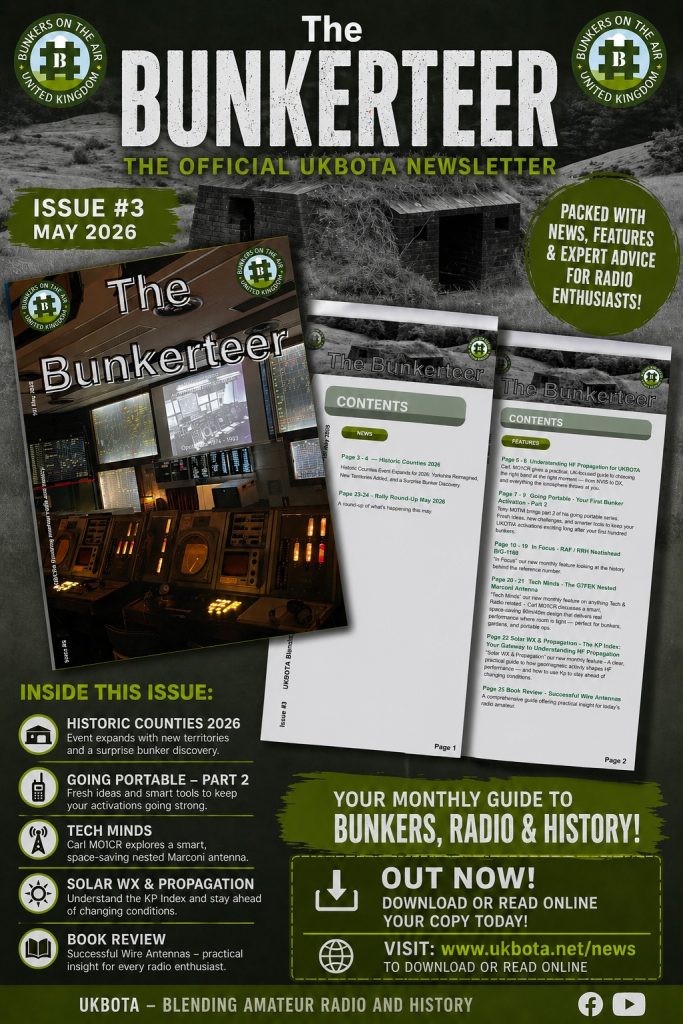
Bunkterteer Magazine
Click here to read the current and previous editions.
New articles always welcome!
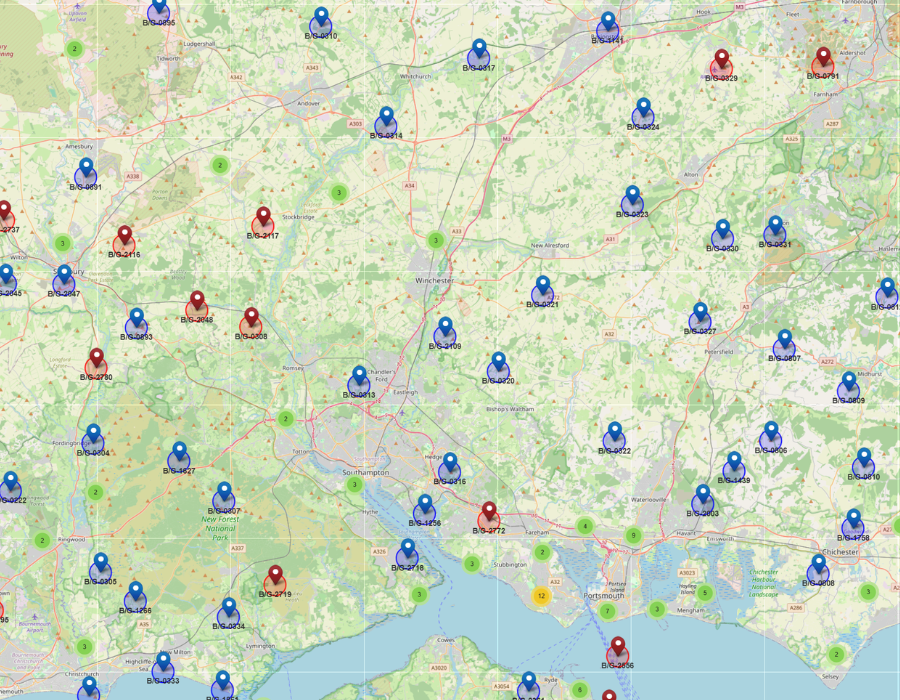
Where are the bunkers?
UKBOTA Rules
General Rules - update 3 July 2026
1. Safety and Permissions
Activators are strongly advised to seek permission
from land owners and to conduct a personal safety assessment before conducting
an activation. The listing of of a bunker on our UKBOTA reference
list does not in anyway indicate that a bunker, or the vicinity of a bunker, is
either safe or legal to enter. Always ask permission. UKBOTA accepts no responsibility for any issues
arising from the activation of a bunker, eg. failing to ensure appropriate
access to a site or for matters regarding personal safety.
2. Terminology
2. The abbreviation UKBOTA is Copyright and refers to
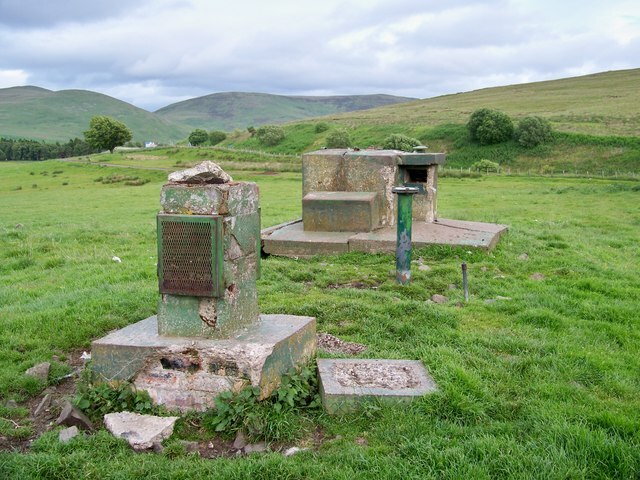
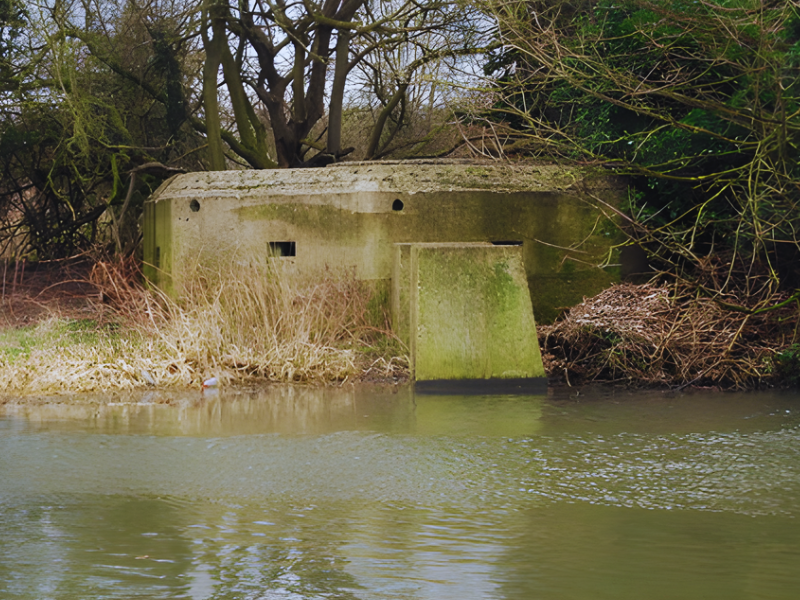
the United Kingdom Bunkers On the Air Award Scheme. For the purposes of UKBOTA, a bunker is 20th
Century fortified or hardened structure for the purposes of positional defence,
observation or crisis management. Types of bunkers included in the UKBOTA list
include: Royal Observer Corps HQ and Observation Posts, Declassified military
and civil defence bunkers, storage and utility bunkers, Airfield Battle HQ,
blast shelters, air raid shelters and some pillboxes. Many bunkers are
undergound, but by no means all. A UKBOTA Bunker ‘reference’ is a bunker listed on
the UKBOTA Master List, the latest version of the list can be found at
www.bunkerbase.org on the Bunker Dashboard. An activator is a station conducting amateur radio
operations from a UKBOTA referenced bunker. A hunter is a station chasing activator stations,
i.e. conducting QSOs with stations located at UKBOTA bunkers as listed in the
UKBOTA Master List. VHF in the context of UKBOTA awards refers to any
band above, and inclusive of, 6m (50MHz). A QSO between two activators at two different
bunkers is referred to as a ‘bunker to bunker QSO’ or ‘B2B’ for short. In some cases it will be possible for an activator
to activate more than one bunker at a time. The maximum permitted is 5 at a
time. Multi-bunker activation, eg. an activation of 5 bunkers, is often
shortened to ‘5fer’ etc.
3. Valid UKBOTA QSO
A valid UKBOTA QSO must be unassisted. Both
stations must be able to copy callsigns, signal reports, and confirmations
without the assistance of a third-party station. For the purposes of UKBOTA awards, a valid QSO requires that the licensed
operator whose personal callsign is being used is the person physically
operating the radio equipment and conducting the full QSO exchange themselves. Unattended operation is not permitted. Whilst the QSO exchange above describes the
minimum requirement for a QSO many activators will chose to give other
information. Where possible it is often useful, and of interest to the hunter,
to describe a little about the history/geography of the bunker(s) being
activated. The use of WebSDR to receive signal reports under
poor band conditions is not permitted. The use of remote stations by hunter is permitted. The use of repeaters is not permitted. Activators and hunters may use any amateur radio
band and mode their licence permits. Operating outside individual licence conditions
will render a QSO invalid. UKBOTA strongly encourages participants to observe
the DX Code of Conduct details of which can be found here:
https://www.iaru-r1.org/on-the-air/spectrum-abuse/dx-code-of-conduct/
4. Valid UKBOTA Activation
Generally, an activator requires 25 QSOs on HF or
mixed HF/VHF, or 5 on VHF only, to make an activation valid and these activations
can be completed over different days. QSO on different bands with the same
hunter count as an additional QSO towards the validation requirement. QSO using
different modes with the same hunter do not count as an additional QSO towards
the validation requirement (unless they occur on a different day). Whilst these
general rules cover most awards specific award requirements should also be
checked as they may differ. An activator may not activate from the fixed home
station even if it falls within the activation zone, there are two exceptions: 1. An activator may activate from their property
if it falls within the activation zone if they are operating away from their
main shack and using battery power and not using their main station antennas,
eg. ‘garden portable’ or operating from your driveway in your car with mobile
radio and antenna. 2. An activator may activate from a bunker
activation zone, using mains power and a fixed antenna providing that either a
Special Event Callsign or Club Callsign is used. The use of /P and /M appended to the callsign is
no longer required under UK licence conditions and is, therefore, not mandatory
for UKBOTA activations. The use of Regional Secondary callsign prefixes
(eg. GM for Scotland) is no longer required following recent changes to UK
licence conditions, however, activators are enouraged to use regional prefixes
by UKBOTA. An activator must be ‘activating the bunker’, it
is not sufficient to ‘know’ that a station is in an activation zone, if they
are not specifically conducting a bunker activation, for it to count as a valid
UKBOTA QSO. The activation zone for a UKBOTA bunker is 1000m,
ie. the activator must be within 1000m from the location of the bunker shown on
the UKBOTA list. Where possible many activators like to operate from as close
to a bunker as possible, noting the importance of safety and site permissions. A hunter and activator may be within the
activation zone of the same bunker for a valid QSO.
5. Activating more than one bunker at a time
Some bunkers are close together and where their
activations zone intersect, ie. within the ‘overlap area’ it is possible to
activate both bunkers. In some cases up 5 bunkers (the maximum UKBOTA permit)
by all overlap and in the area were they *all* overlap then all 5 may be
activated for a 5fer.
6. Activating other schemes at the same time as UKBOTA
UKBOTA welcome multi-scheme
activations, e.g. where the activation location allows, for the activation of a
POTA Park, Lighthouse and UKBOTA bunker simultaneously. Activators are encouraged to check the rules of
other schemes for their specific rules and guidelines.
To help keep things clear and focused, we kindly
ask that spots are posted on the WWBOTA cluster or bunker-related social media
only when the activation includes a bunker. Activations that are parks-only or
summits-only should please be spotted via their respective schemes instead.
7. Multiple personal callsigns
An operator may use any of their own legally-held personal callsigns for activating or hunting — multiple-personal-callsign use is permitted in line with the terms of your licence when hunting to help an activator “over the line”, i.e. the minimum QSO threshold . However, only one QSO per band/mode combination will be credited to the hunter’s UKBOTA account, regardless of which of the operator’s personal callsigns was used for each contact.
8. Multi-user callsigns
The use of club callsigns and special event callsigns is permitted. The operator must either be the Notice of Variation holder (NoV holder, or national equivalent) themselves, or hold explicit, specific permission from them to use that callsign. Note: club callsigns and special event callsigns must not be added as an additional callsign on a personal account, regardless of current or intended usage. A separate account must be created for each such mutli-operator callsign. This is because special event callsigns may be reissued to different operators over time, and club callsigns by definition are used by more than one operator, so single-operator use at any given point cannot be relied upon as a permanent property of the current callsign user. Using a separate account ensures award credit always reflects either the operator who actually made each QSO, or the club itself — rather than being misattributed to whichever individual happens to hold the account.
9. Callsign prefixes — regional UK callsign
prefixes.
The use of regional callsign prefixes is optional (with the exception
of UK intermediate ‘2’ callsigns). For example, an operator licensed in England
may activate a bunker in Scotland without adopting the Scottish ‘M’ designation
(e.g. operating as M0ABC rather than MM0ABC). This applies equally to all UK
and Crown Dependency callsign variants, including those for England, Scotland,
Northern Ireland, Wales, the Isle of Man, and the Channel Islands. Note: this
optionality applies only to UK domestic regional prefixes. It does not apply to
reciprocal or CEPT visiting operation, where use of the host country’s
mandatory callsign prefix, in accordance with CEPT T/R 61-01 as implemented by
Ofcom, is required and is not optional.
10. Remote Operation
Note: hunters have no location
requirement, so remote operation is permitted provided the station functions as
a single coherent unit. Activators must be physically present within the
bunker’s activation zone at all times; this requirement cannot be satisfied by
any remote arrangement, however configured.
Hunters are permitted to use a remotely
operated station to work bunker activators, provided the transmitter and
receiver are co-located with each other (i.e. operated as a single remote
station). Using a WebSDR, or any other internet-based remote receiver, to
complete part of a QSO is not permitted — this applies whether the remote
element is the receiving side, the transmitting side, or both.
Activators are not permitted to use a remote connection to activate a bunker. This includes, but is not limited to:
a. Connecting remotely to a station located at the bunker — e.g. using a mobile (eg. cellular/WiFi/Internet) connection from home to operate a fixed club station sited at the bunker.
b. Connecting remotely from within the bunker’s activation zone to a station located elsewhere — e.g. using a mobile (eg. cellular/WiFi/Intenet)connection from the bunker to transmit and receive via a home station. c
c. Completing the contact via an internet-linked repeater or gateway (e.g. EchoLink, IRLP, or similar) rather than a direct RF path, even where the activator’s own transmitter and receiver are both physically present at the bunker.
d. Any other arrangement where either the
transmitter or the receiver used for the activation is not physically present
within the bunker’s activation zone.
Getting help
The best and quickest place to ask for help is via
our support tickets system.
Getting Started - Activator
This guide should get you started on your UKBOTA bunker activator journey.
✅ To find suitable bunkers to activate a good start point is the UK Portable Ham Map, see the link on the page and here. Thanks go to Steve Hiscocks, M1SDH for mapping. Steve is also on the UKBOTA Management Team.
✅ Check rules, awards and First Time tip. Note 1000m and typically 25 QSO HF and 5 QSO VHF.
✅ Many bunker activators enjoy to, and are encouraged to, activate bunkers at the same time as references for other schemes, e.g. POTA. The UK Portable Ham Map shows overlays of not only UK bunkers on our ‘Reference list’ but also other popular schemes such as POTA, WWFF and SOTA. A list view of the UKBOTA bunkers, which also includes latitude and longitude, Ordnance Survey Grid Reference, Nearest Postcode and Worked all Britain Square (of the bunker) is here.
✅ Note that each bunker ‘reference’ begins with a ‘B’ and a ‘/’ followed by a country code and then a four digit number. UKBOTA covers bunkers in England (B/G), Scotland (B/GM-), Northern Ireland, Wales, the Isle of Man, Jersey and Guernsey.
✅ Most bunker operations centre on 40m and 20m SSB but other bands are increasingly popular including the higher HF bands, and also VHF and above. CW, FT8 and other modes are also popular – give it a go and call “CQ Bunkers on the Air”. There have been bunker activations in SSB, CW, FT8,FT4, RTTY, PSK and SSTV!
✅ You will find it useful to ‘spot’ yourself (or have someone spot you) when you activate. There are various way to do this either through our internal ‘cluster’, which requires registration to spot but not to view (see the menu above). Many like to use the ‘cluster’ version with the embedded (and quite excellent) fieldspotter.radio map (by Ian Renton, M0TRT) which gives an excellent visualization of WWBOTA spots (as well as POTA and other schemes) and a handy band map for finding other bunkers and having a ‘bunker to bunker’ (B2B) QSO.
✅ Spots made on the WWBOTA ‘cluster’ are automatically forwarded to our bespoke WhatsApp Spots and Alerts Group. The WWBOTA WhatsApp spots and alerts group is here. Please note that group is just for spots and alerts, not general chat.
✅ Self-spots, which are automatically forwarded to our internal ‘cluster’ and the WWBOTA WhatsApp Spots and Alerts Group, may be made using the excellent Ham2K Portable Logger.
✅ If you have any questions about UKBOTA consider joining our social media channels, links are on this homepage.
✅ Finally, watch some of the videos embedded below, they will give you a good idea of what to expect.
⚠️ ⛔ Please Note that UKBOTA takes NO responsibility for safety or right of access issues. If you are unsure then check with the land owner and never activate inside a bunker, or enter private property, or restricted areas, unless you have permission and it is safe to do so.
Getting Started - Hunter
✅ Find stations calling “CQ Bunkers on the Air” and work them! It’s really that simple!
✅ For UKBOTA Award information see the Awards page linked at the menu at the top of this page
✅ Consider using our internal ‘cluster’ linked above to help you find bunker activations. Note that you do not need to register to view the WWBOTA ‘cluster’ or fieldspotter.radio
✅ Read the Bunker Activator guide, much of that information will also be useful to you.
✅ If you have any questions about UKBOTA consider joining our social media channels, links are on this homepage.
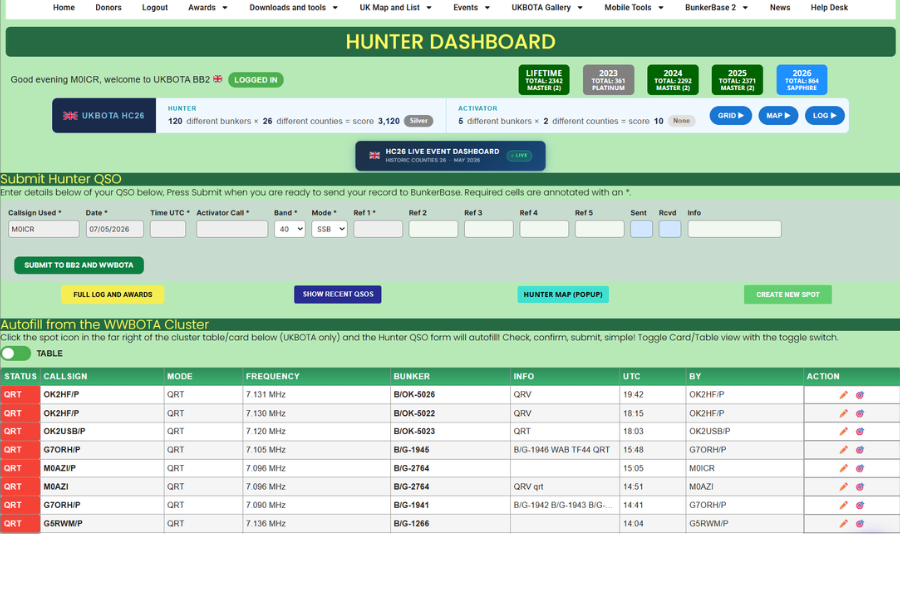
Dashboards and Logging
Here at UKBOTA we pride ourselves on provding all particpants with a feature rich and easy to use system. At the heart of the UKBOTA system is a some complex IT system with a powerful database, API and rich user-friendly interface, 95% of users won't be interested in the technology just the we have a really nice interface for you to record,view and manage your UK bunkers related information!
UKBOTA informationis built around 3 types of data:
- *Actiavtor and Activations data
* Hunter Data
* Bunker Data
Each of these can be accessed through a dashboard, a dashboard is just a fancy name for a dedicated webpage.
This is for activators to upload logs (in correctly formatted ADIF files) and to see there UKBOTA Activator 'score'. From the Activator dashboard the activator can find a link to list of all of their activations, awards scores and award claims. A quick link to this dashboard can be found by clicking the purple dashboards button in the right hand corner of the screen. This dashboard can also be found be clicking here.
Hunter Dashboard
This is for hunters to record their QSOs and to see there UKBOTA Hunter 'score'. From the Hunter dashboard the hunters can find a link to a log of all of their UK bunker QSOs, awards scores and award claims. A quick link to this dashboard can be found by clicking the purple dashboards button in the right hand corner of the screen. This dashboard can also be found be clicking here.
Bunker Dashboard
This dashboard is for both activators and hunters to explore our UKBOTA bunkers via either a list or map. Additionally, this dashboard contains a link to the excellent M1SDH Portable Map which provides geographical details for a number of portable schemes including POTA, SOTA and of course UKBOTA. his dashboard can also be found be clicking here.
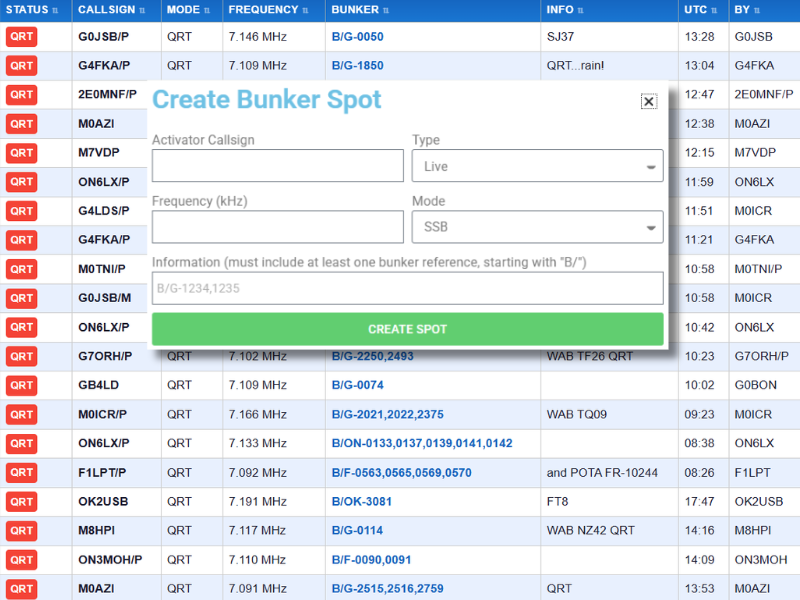
A guide to spotting
If you’re just getting started with posting activations, here’s a simple breakdown of how to get your spot out there:
🟢 Option 1: Self-Spot using Ham2K PoLo
This is the easiest and most powerful option. When you self-spot your activation using the Ham2K PoLo portable logger, it’ll automatically send your spot to:
– The Ham2K Spots List
– The WWBOTA Cluster
– Our WWBOTA Spots & Alerts WhatsApp Channel
– www.fieldspotter.radio
🟡 Option 2: Spot Directly on the WWBOTA Website Cluster
Head over to https://wwbota.net/cluster pop your spot onto the cluster (you’ll need to register first, this is not the same as your UKBOTA registration). This will also auto-share your activation to:
– The WhatsApp Spots & Alerts Channel
– www.fieldspotter.org
You can also access our cluster by clicking the purple actions button in the bottom right hand corner of this screen and selecting WWBOTA Cluster
🔴 Option 3: Post Straight into the WhatsApp Spots & Alerts Channel
If your internet isn’t playing ball and you can’t access the cluster, just drop your spot directly into the WhatsApp group. It works — but just a heads-up: this won’t forward your spot anywhere else.
🔥Best bet? Use Option 1 or 2 if you can — they reach the most people automatically.🔥
And of course, you’re always welcome to share your spot manually in other radio chat groups or the main DX Cluster.
🔐 Lost your WWBOTA cluster password? No problem — just ping one of the team and we’ll get it reset for you.
Enjoy the activations & have fun out there!
73, Carl
UKBOTA Atlas
Introducing the UKBOTA Bunker Atlas.
One of the things that makes UKBOTA special is the community behind it. Licensed amateur radio operators across the UK activating Cold War bunkers, ROC posts, radar stations and wartime structures — not just logging contacts, but visiting places with real history. For a long time we've wanted a way to capture that knowledge and share it, and today we're doing exactly that.
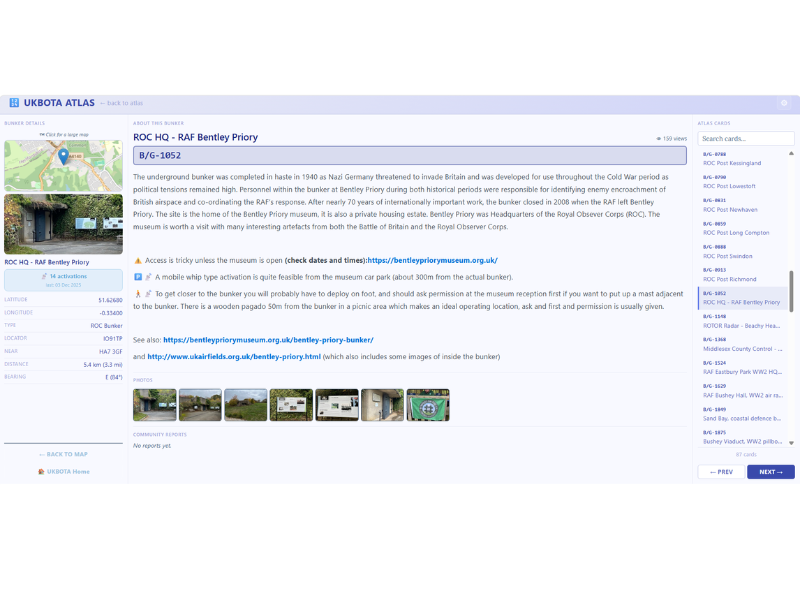
We're delighted to introduce the UKBOTA Bunker Atlas — a community-built guide to UK bunkers, available now at ukbota.net/atlas.
What is the Atlas?
The Atlas is a living, community-maintained database of bunker cards. Each card brings together everything useful about a specific UKBOTA site — its history, construction, current condition, access notes, activation tips, photos, and a record of how many times it has been activated. Think of it as the field guide we always wished existed when we were planning our own activations.
Cards are linked directly to the WWBOTA database, so coordinates, locator squares and site type are pulled in automatically. When you open a card, you can see the site on an interactive map, browse photos contributed by fellow members, read field reports from activators who have been there, and even get your distance and bearing from your current location.
Built by the community, for the community
The Atlas is only as good as the information members put into it. Any logged-in UKBOTA member can contribute — whether that means writing a description of a site you know well, sharing photos from a recent activation, or submitting a field report about access conditions, parking, antenna options and anything else that might help the next activator.
All contributions are reviewed before they appear publicly, so the information stays accurate and useful. If you've activated a site and learned something others should know, this is the place to share it.
A new way to explore
The Atlas page is designed to be used on any screen — desktop, tablet or mobile. The landing page shows a map of all bunkers that currently have cards, with a live count of how many sites are covered out of the full WWBOTA database. Bunkers updated in the last 24 hours glow on the map so you can see where new information has just been added.
Click any pin and the full card opens alongside the map. You can browse all cards in the sidebar, navigate between them with Prev and Next, and share a direct link to any individual card — useful if you want to point someone to a specific site.
What's there so far
We have made a start, but the Atlas is far from complete — and that's the point. There are over 3,700 bunkers in the UKBOTA database. Each one that gets a card becomes a little more knowable, a little more accessible, and a little more likely to be activated. If you've been to even one of them and have something to add, please do.
How to contribute
Visit ukbota.net/atlas and log in with your UKBOTA account. Search for a bunker reference, open the card, and use the Add Field Report button to share what you know. Photos are very welcome — they really bring a site to life for people who haven't been there yet.
We're looking forward to seeing the Atlas grow. 73 de M0ICR
What is WWBOTA?
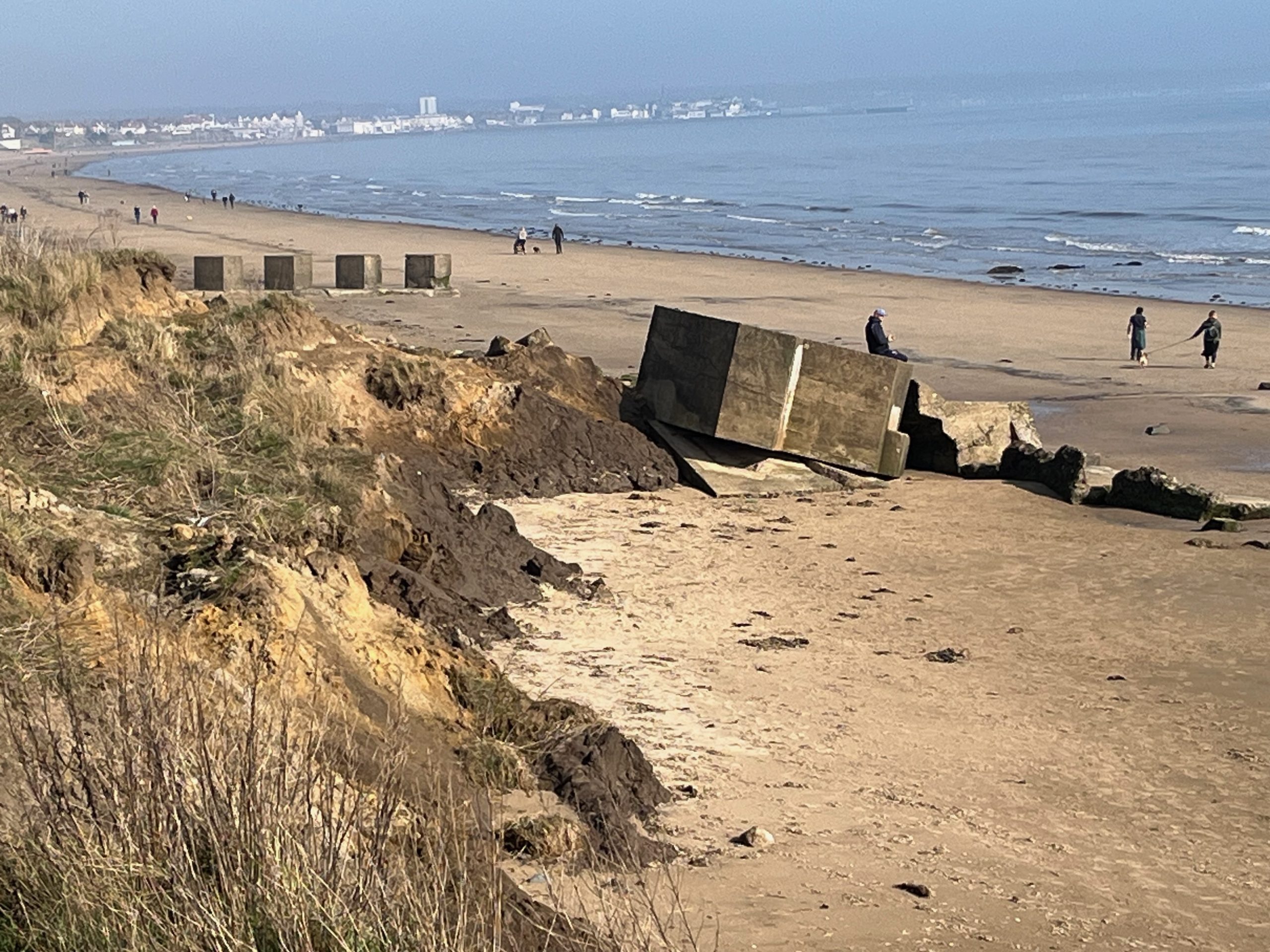
Worldwide Bunkers on the Air (WWBOTA) is an amateur radio activity that brings together two powerful human instincts — the desire to communicate across borders, and the impulse to understand and preserve our shared history. Bunkers are among the most visceral physical remnants of the conflicts and tensions that shaped the modern world. From coastal fortifications to Cold War command centres, from anti-aircraft emplacements to civil defence shelters, they exist in almost every country — silent witnesses to moments of national and international significance. WWBOTA exists to draw attention to these structures, to promote interest in them as part of our collective heritage, and to connect the amateur radio community across the international boundaries that those bunkers were so often built to defend.
WWBOTA is not a competitive programme. We do not publish league tables or rankings. What we do is driven by the spirit of shared endeavour rather than a contest. WWBOTA is about more than numbers.
WWBOTA operates as a two-tier system. At the international tier, WWBOTA rewards and promotes cross-border bunker activity — contacts between operators in different countries, activations across multiple nations, and the building of relationships across the worldwide bunker community. At the national tier, affiliated schemes provide domestic awards and activities calibrated to the realities of their own country’s bunker landscape. Together, the two tiers form a complete ecosystem — one that welcomes the newest activator visiting their first local bunker, and the most experienced operator chasing contacts across continents.
Every activation is an act of historical engagement. We invite you to join us — and to know a little about the bunker you visit, not just its reference number.
As the founding programme within WWBOTA, United Kingdom Bunkers on the Air (UKBOTA) is aligned with the WWBOTA Founding Statement and Values.
Visit the WWBOTA homepage here.
WBB September 2026
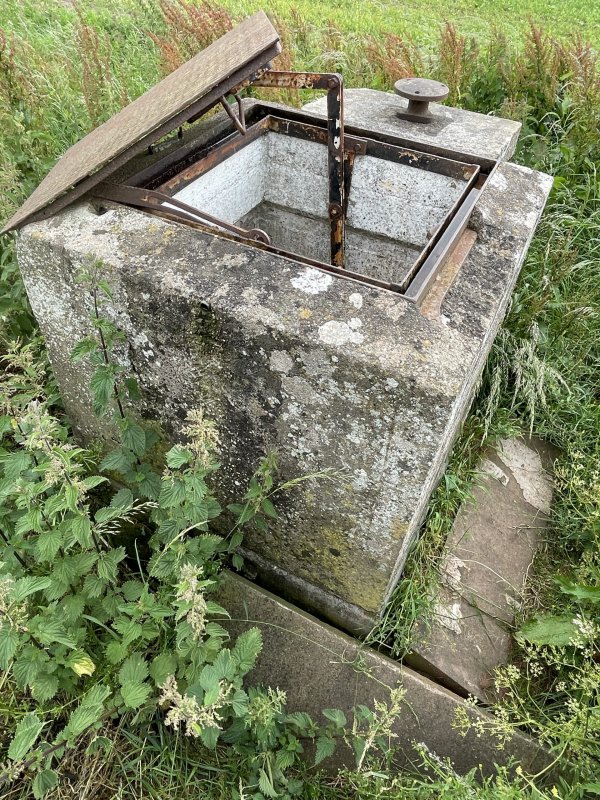
ROC26 October 2026
Advent26 December 2026
Mad March Hare 27 - March 2027