

The Act of Remembrance
The Act of Remembrance
The Act of Remembrance for Britain and the Commonwealth
The Act of Remembrance in the United Kingdom is a moment shared across generations, across nations, and across the Commonwealth. It is the time when we pause to honour all those—soldiers, sailors, airmen, medics, engineers, volunteers, and civilians—who served, suffered, and fell in conflicts past and present. It is a promise that their courage, their sacrifice, and their stories will never be forgotten.
Its roots lie in a single moment in history: the 11th hour of the 11th day of the 11th month, 1918. At that precise time, the guns of the First World War fell silent. After four years of unimaginable loss, the Armistice came into effect, ending the fighting on the Western Front. That moment of silence was not just the end of a war—it was the beginning of remembrance. It marked the instant when millions of families across Britain and the Commonwealth finally breathed, mourned, and hoped again.
This is why we still hold the Two Minutes’ Silence at 11am. It is not a ritual for ritual’s sake—it is a direct link to that moment when peace returned, and the world stood still. When we bow our heads today, we stand in the same silence that fell over the trenches, the ships at sea, the hospitals, the factories, and the homes waiting for news. It is a silence that belongs to all of us.
Armistice Day, on 11 November, marks that historic moment. Remembrance Sunday, held on the nearest Sunday, allows the whole nation to gather—families, veterans, serving personnel, community groups, and leaders—to reflect on every life lost in conflict since 1914. Together, they form the UK’s Act of Remembrance: a shared commitment to honour the fallen of both World Wars, later conflicts, peacekeeping missions, and those who serve today.
We remember not only Britain’s forces but the vast contribution of the Commonwealth—Canada, Australia, New Zealand, India, South Africa, the Caribbean nations, and many others—whose people stood shoulder to shoulder with Britain in times of need. Their service shaped the freedoms we enjoy today. Their sacrifice is woven into our history.
The Act of Remembrance is not about glorifying war. It is about recognising humanity: the bravery of ordinary people in extraordinary circumstances, the cost of conflict, and the hope for peace. It is about gratitude, unity, and the quiet promise that we will carry their memory forward.
At the 11th hour, on the 11th day, of the 11th month, we pause. We remember. And we honour them—Britain and the Commonwealth, together.
The First Act of Remembrance — 11 November 1919
The First Act of Remembrance — 11 November 1919
The First Act of Remembrance — 11 November 1919
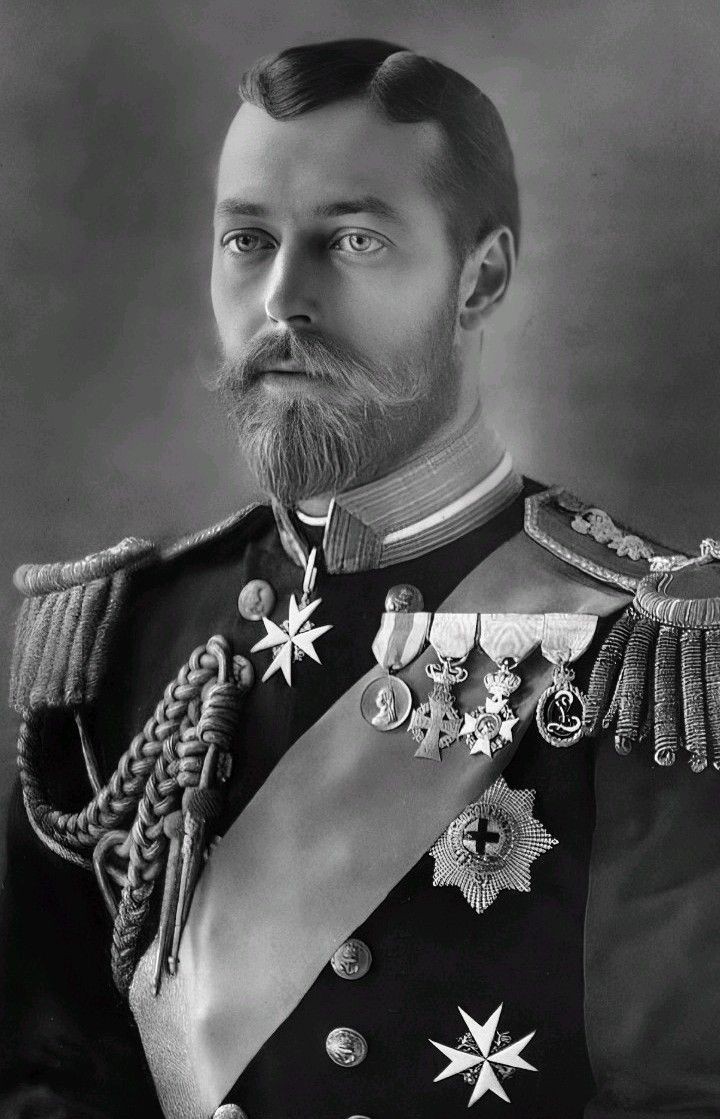
The United Kingdom’s first official Act of Remembrance took place on 11 November 1919, exactly one year after the Armistice that ended the fighting of the First World War. King George V asked the nation to observe a Two Minutes’ Silence at 11am, matching the precise moment the guns fell silent on the Western Front — the 11th hour of the 11th day of the 11th month.
This was the first time the entire nation paused together in shared stillness. Across Britain and the Commonwealth, people stopped where they stood: factory machines slowed to silence, traffic halted in the streets, offices and schools paused, and communities bowed their heads in reflection. It was a simple act, but profoundly powerful. In that moment, grief, gratitude, and unity were expressed without a single word spoken.
The timing itself carries deep significance. At 11am on 11 November 1918, the Armistice came into effect, ending four years of devastating conflict. For millions of families across Britain and the Commonwealth, that moment marked the end of fear and uncertainty. It was the instant when the killing stopped, when hope returned, and when the world finally exhaled. By holding the silence at the exact same time one year later, the nation anchored remembrance to the moment peace was restored.
The 1919 observance became the foundation of the UK’s remembrance tradition. It established the Two Minutes’ Silence, the annual act of reflection, and the commitment to honour all who served and fell — not only from Britain, but from the many Commonwealth nations whose people stood alongside British forces in the darkest days of the war. Their sacrifice, courage, and service are woven into the fabric of remembrance.
From that first silence in 1919 grew the ceremonies, memorials, and traditions we recognise today. But at its heart, the Act of Remembrance remains what it was on that morning: a quiet, shared promise that the fallen will never be forgotten.
The Cenotaph — Its History and Importance
The Cenotaph — Its History and Importance
The Cenotaph — Its History and Importance
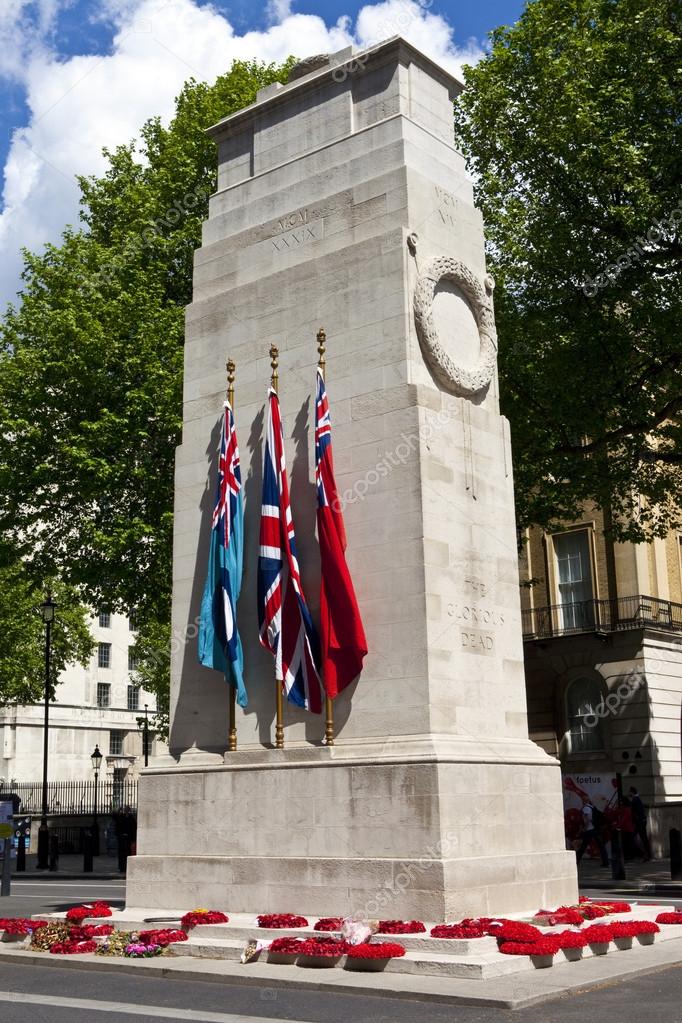
The Cenotaph in Whitehall, London stands as the United Kingdom’s central memorial to the fallen of the First World War, the Second World War, and all conflicts since. Its name, taken from the Greek kenos taphos meaning “empty tomb,” reflects its purpose: to honour those who died far from home and have no known grave. It is a monument not to one individual, but to all who served and sacrificed.
The Cenotaph began as a temporary structure. In 1919, architect Sir Edwin Lutyens was commissioned to design a memorial for the Peace Day celebrations marking the end of the First World War. His design was striking in its simplicity — a stark, tomb‑like form rising from a clean, geometric base. When unveiled, it immediately resonated with the public. Within days, vast crowds gathered to lay wreaths and pay their respects, treating the temporary monument as a sacred place of mourning. The depth of public feeling made it clear that the Cenotaph had become far more than a ceremonial prop.
In response, a permanent version was commissioned. Built from Portland stone, the new Cenotaph was unveiled by King George V on 11 November 1920, in a ceremony that also saw the Unknown Warrior brought to Westminster Abbey. These two acts — the unveiling of the Cenotaph and the burial of the Unknown Warrior — together established the foundations of Britain’s modern remembrance tradition. They provided a national focus for grief, reflection, and unity at a time when nearly every family across Britain and the Commonwealth had been touched by loss.
Lutyens’ design is deliberately non‑religious, allowing the Cenotaph to belong to people of all faiths and backgrounds. Its inscription, “The Glorious Dead,” honours every life lost without distinction of rank, regiment, or nationality. The absence of names is intentional: it ensures that the monument stands for all who served, allowing each visitor to bring their own memories and meaning to the space. Its simplicity is its strength — a quiet, dignified presence that speaks more powerfully than any ornate decoration could.
Since 1920, the Cenotaph has been the focal point of the National Service of Remembrance, held each year on Remembrance Sunday. Members of the Royal Family, political leaders, veterans, serving personnel, faith representatives, and thousands of spectators gather here to honour the fallen. The Two Minutes’ Silence is observed at the Cenotaph, echoing the stillness first held in 1919. Wreaths are laid, prayers are spoken, and the nation pauses together in reflection.
The Cenotaph also stands as a symbol of the shared sacrifice of the Commonwealth, whose nations fought alongside Britain in both World Wars and in later conflicts. It represents unity across borders and generations, reminding us that remembrance is not confined to one nation but shared by many.
Today, the Cenotaph remains one of the most important memorials in the world. It is a place where history, memory, and national identity meet — a reminder of the cost of conflict and the hope for peace. More than a century after its unveiling, it continues to be revered as a national shrine, a gathering point for remembrance, and a solemn promise that the fallen will never be forgotten.
The National Memorial Arboretum — A Living Place of Remembrance
The National Memorial Arboretum — A Living Place of Remembrance
The National Memorial Arboretum — A Living Place of Remembrance
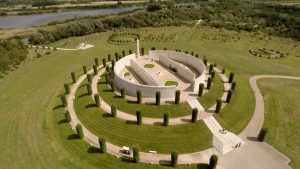
The National Memorial Arboretum, located in Staffordshire, is the United Kingdom’s centre for living remembrance. Unlike traditional stone monuments, the Arboretum is a landscape of trees, gardens, and memorials that grow and change with time. It stands as a place where memory is not only preserved but continually renewed, offering a peaceful environment for reflection, learning, and honouring those who served.
Opened in 2001, the Arboretum was created with a clear purpose: to provide a national space that complements the Cenotaph and other formal memorials by offering a more personal, contemplative setting. Its founders envisioned a place where remembrance could be experienced in nature — where the cycle of growth, seasons, and renewal would echo the enduring legacy of service and sacrifice. Today, the Arboretum spans over 150 acres and contains more than 400 memorials dedicated to the Armed Forces, emergency services, civilian organisations, and Commonwealth partners.
At the heart of the Arboretum stands the Armed Forces Memorial, a striking stone structure dedicated to all members of the British Armed Forces who have died on duty or as a result of their service since 1948. Its curved walls bear the names of thousands of men and women, and its design incorporates a powerful moment each year: at 11am on 11 November, a shaft of sunlight passes through a precise opening and illuminates the central wreath sculpture. This annual alignment symbolises the nation’s commitment to remembrance and connects the Arboretum directly to the significance of the eleventh hour of the eleventh day.
The Arboretum’s memorials reflect the breadth of service across Britain and the Commonwealth. From regimental monuments and civilian service tributes to gardens dedicated to specific conflicts, each space tells a story. Visitors can walk among trees planted in honour of individuals, units, and organisations, creating a landscape where remembrance is both collective and deeply personal. The natural surroundings encourage quiet reflection, making the Arboretum a place where people can grieve, remember, and find peace.
Education is central to the Arboretum’s mission. Its Remembrance Centre provides exhibitions, archives, and learning programmes that help visitors understand the human experiences behind the memorials. Schools, veterans’ groups, families, and international visitors come to learn about the cost of conflict, the importance of service, and the shared history that binds Britain and the Commonwealth. In this way, the Arboretum ensures that remembrance is not only ceremonial but also educational and accessible to future generations.
The National Memorial Arboretum is more than a memorial site — it is a living tribute. Its trees grow taller each year, its gardens evolve, and its memorials continue to expand as new stories of service and sacrifice are added. It stands as a reminder that remembrance is not confined to a single day or a single monument. Instead, it is a continuous act of honouring those who served, those who fell, and those who continue to protect and support our communities.
In its quiet paths, its open spaces, and its carefully crafted memorials, the Arboretum offers a place where the nation can come together to reflect, remember, and renew its commitment to peace. It complements the solemnity of the Cenotaph with a landscape of life, ensuring that the legacy of Britain and the Commonwealth’s service endures in both stone and nature.
UKBOTA Lest We Forget Award
UKBOTA Lest We Forget Award
DURATION:
5th – 11th November 2025.
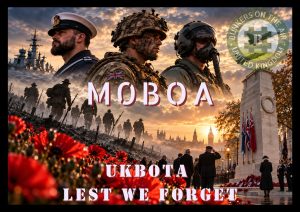
We respectfully request UKBOTA activators to observe the national 2 minutes silence at 1100hrs 11th November 2025.
RULES:
Activators: Successfully activate any UKBOTA bunker between the 5th and 11th November 2025.
Hunters/SWL: Successfully hunt / log any UKBOTA bunker activation between the 5th and 11th November 2025.
Note: There are no award levels for this event. The award certificate is gained from one or more activations or hunted activations.
To be eligible for an Award Claim, participants must upload a record of a UKBOTA activation, or a QSO with a UKBOTA bunker activation, that took place between 5th and 11th November 2025.
Lest we forget award
Lest we forget award

The Royal British Legion
The Royal British Legion
The Royal British Legion and Their Role in the Act of Remembrance
The Royal British Legion stands at the heart of the United Kingdom’s remembrance tradition. Founded in 1921, just three years after the Armistice, the Legion was created to support those who had returned from the First World War and to ensure that the sacrifices of the fallen would never fade from national memory. Today, more than a century later, the Legion remains the leading voice of Remembrance across Britain and the Commonwealth.
The Legion’s role is both practical and symbolic. Every year, they lead the nation in honouring all who served and all who fell in the line of duty. Their work shapes the ceremonies we recognise today: the Two Minutes’ Silence, the laying of wreaths, the gathering at the Cenotaph, and the countless acts of remembrance held in towns, villages, and communities across the country. Through these traditions, the Legion ensures that the meaning of Remembrance remains clear, inclusive, and deeply rooted in our shared history.
One of the Legion’s most visible contributions is the Poppy Appeal, a symbol born from the battlefields of the First World War. The red poppy has become an emblem of remembrance recognised throughout the world, representing both the cost of conflict and the hope for peace. The Legion’s stewardship of this symbol helps unite millions of people each year in reflection and gratitude.
Beyond ceremony, the Royal British Legion provides lifelong support to serving personnel, veterans, and their families. Their work reminds us that remembrance is not only about the past — it is also about caring for those who continue to bear the physical and emotional scars of service. In this way, the Legion bridges the gap between history and the present, ensuring that remembrance is not just an annual ritual but a living commitment.
Through their leadership, advocacy, and compassion, the Royal British Legion remains pivotal to the Act of Remembrance. They safeguard its traditions, uphold its values, and help the nation honour the service and sacrifice of Britain and the Commonwealth. Their work ensures that remembrance is not merely observed, but truly understood.

The Poppy Appeal
The Poppy Appeal
The Poppy Appeal
The Poppy Appeal is one of the most recognisable and enduring symbols of remembrance in the United Kingdom and across the Commonwealth. Run each year by the Royal British Legion, the Appeal raises vital funds to support serving personnel, veterans, and their families — while also helping millions of people take part in the Act of Remembrance.
The poppy’s origins lie on the battlefields of the First World War. In the devastated landscapes of Flanders and northern France, bright red poppies were among the first plants to grow again. Their appearance inspired Lieutenant Colonel John McCrae’s famous poem In Flanders Fields, which captured the contrast between the beauty of the flowers and the immense human cost of the war. The poppy soon became a symbol of remembrance, resilience, and hope.
The first Poppy Appeal was held in 1921, just months after the Royal British Legion was founded. That year, millions of poppies were sold to support those who had returned from the war — men and women who faced hardship, injury, and loss. The Appeal quickly became a national tradition, and the poppy itself grew into a powerful emblem worn with pride across Britain and the Commonwealth.
Today, the Poppy Appeal remains central to the Act of Remembrance. Wearing a poppy is a personal gesture, but it carries a shared meaning: gratitude for those who served, recognition of the sacrifices made, and a commitment to honour the fallen. The Appeal also ensures that remembrance is not only symbolic but practical. Funds raised provide essential support for veterans and their families, from mental health services and financial assistance to rehabilitation, housing, and community programmes.
The poppy is not a symbol of war — it is a symbol of remembrance. It represents the hope for peace, the resilience of those who served, and the promise that their sacrifices will never be forgotten. Through the Poppy Appeal, the Royal British Legion keeps that promise alive, year after year.